Woulday Script Font: Elegant & Practical for Handmade Brands
If you've ever spent hours tweaking letter spacing on a wedding welcome sign, struggled to find a script font that cuts cleanly on your Cricut, or watched customers scroll past your Etsy listing because the typography felt “off”—you’ll understand why Woulday has become my go-to script font for physical and digital product creation. It’s not just another pretty handwritten typeface. Woulday is a refined, modern script font from the Script Amp collection—designed with crafters and small business owners in mind, not just graphic designers.
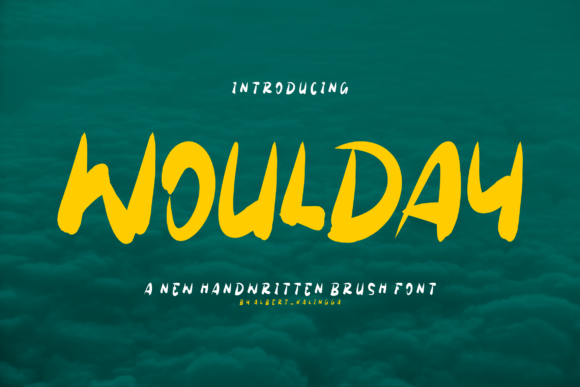
Visually, Woulday walks a thoughtful line: it’s elegant without being fussy, fluid without sacrificing clarity, and contemporary without losing warmth. The strokes have graceful contrast—slightly tapered, with soft entry and exit points—and subtle organic variation that feels hand-drawn but never inconsistent. Unlike some script fonts that blur together at small sizes or collapse when cut as vinyl, Woulday holds its shape beautifully across scales—from 8-point boutique tags to 24-inch farmhouse wall art.
I use Woulday daily across my printable shop and custom label business. For candle makers, it works perfectly on kraft paper labels—especially paired with a clean sans serif like Montserrat for ingredient lists. On greeting cards, it adds quiet sophistication to phrases like “You’re loved” or “Happy Birthday, Sarah”—never overwhelming the sentiment, always elevating it. And for wedding stationery? Yes—it shines on save-the-dates, menu cards, and acrylic table numbers. I’ve even used it for laser-cut wooden gift tags (with slight stroke expansion in design software) and it came out crisp every time.
What makes Woulday especially practical for crafters is how well it performs in real production environments. It’s built for readability—not just on screen, but on physical substrates. When cutting with Silhouette Studio or Cricut Design Space, I rarely need to convert to outlines; the curves are smooth and open enough to avoid tiny trapped nodes. For small stickers (think 1.5-inch round tea towel tags or mini soap labels), I keep text above 10 pt and avoid tight kerning on letters like “f” and “y”—and it prints cleanly on both inkjet and laser printers. On mockups, it reads instantly as “premium” without needing gold foil or embossing.
Woulday is best suited for short, high-impact uses: names, titles, quotes, brand slogans, and decorative headings. It’s not intended for body copy—but that’s exactly why it’s so effective in product-based work. Think of it as your visual signature: the font you use for your shop name on packaging, the “Hand-poured” line on your soy wax jar, or the “Est. 2022” flourish on your boutique tote bag tag. Its elegance communicates care and intention—something customers notice before they even read the words.
Pairing Woulday thoughtfully makes all the difference. My most reliable combo? Woulday + a warm, neutral sans serif—like Poppins or Lato. That pairing gives me versatility: Woulday carries the emotional weight (love, celebration, craftsmanship), while the sans serif handles practical info (dates, addresses, care instructions) with quiet authority. For seasonal collections—say, a holiday mug line—I’ll layer Woulday over a subtle serif like Playfair Display for vintage charm, then drop in a thin sans for fine print. No clashing. No visual competition. Just clear hierarchy and brand cohesion.
The font includes OpenType features that matter in production: standard ligatures, discretionary swashes, and stylistic alternates. I use the swashes sparingly—just on the first letter of a wedding invitation headline or the final “y” in a boutique logo—but they add polish without looking overdone. File formats include OTF and TTF, so it loads reliably in Canva, Affinity Designer, Adobe Illustrator, and Cricut Access (when uploaded manually). While it doesn’t include extended Latin or Cyrillic characters, it covers full English, Western European accents, and common punctuation—enough for most U.S.- and Canada-based sellers.
One thing I always double-check before launching a new product: commercial licensing. Woulday is a commercial font, meaning you can use it in physical goods (stickers, mugs, apparel), digital downloads (planner pages, SVG bundles, Canva templates), and client work—as long as you’re not reselling the font file itself. I keep the license agreement saved in my resource folder and reference it before uploading any new printable pack to Etsy. It’s peace of mind that lets me focus on design, not legal guesswork.
In my studio, Woulday shows up everywhere: on hand-lettered-style planner stickers (printed on matte vinyl), as layered text in SVG files for t-shirt designs, on chalkboard-style café menu boards, and even embroidered onto linen napkins via digitized lettering. It’s become part of my brand voice—not because it’s trendy, but because it’s trustworthy. Customers tell me my packaging “feels special,” and while the materials and photography matter, I know the typography does quiet, consistent work behind the scenes.
Seasonally, Woulday adapts gracefully. In spring, it softens botanical labels (“Lavender + Lemon Balm”). In fall, it warms up apothecary jars (“Spiced Maple Syrup”). At Christmas, it wraps elegantly around ornament tags (“Made with Love, 2024”). Its modern elegance avoids cliché—no excessive curls or dated flourishes—so it stays fresh year after year. And because it’s not overly ornate, it pairs seamlessly with minimalist layouts, rustic textures, or bold color-blocking.
If you're choosing a script font for your next product launch, ask yourself: Does it look handmade—but still professional? Does it scale down without breaking? Does it pair easily with other typefaces I already own? Does it come with reliable files and clear commercial rights? Woulday answers yes to all four. It’s not flashy. It doesn’t shout. But in a crowded handmade marketplace, sometimes the most powerful design choice is the one that simply feels *right*—refined, readable, and quietly confident.